
Preparing for the Season: Getting Ready & Staying Ready
Every high school season starts the same way: optimism, excitement, and urgency.
Tryouts are around the corner.
Games are on the schedule.
Athletes feel the pressure to be “ready.”
But here’s the part most people miss—the most dangerous time of the baseball season isn’t the end of the year. It’s the beginning.
In professional baseball, the highest rate of arm injuries consistently occurs in the early months of the season. Not because athletes are throwing too much—but because they weren’t prepared for the stress they were about to face.
High school baseball is no different.
The preseason isn’t about shaking off rust.
It’s about whether the body has been prepared to handle what’s coming next.
The Problem: Most Athletes Confuse Activity With Preparation
Many high school athletes spend their winter bouncing between travel teams, lessons, cages, and “extra work,” then suddenly transition into full-speed high school practices.
From a training standpoint, that jump can be massive.
Different athletes enter the season with wildly different backgrounds:
Some trained consistently with structure and intent
Some only played games
Some lifted without throwing
Some threw without lifting
Some did a little of everything with no real plan
Yet once the season starts, everyone is expected to handle the same practice demands.
That’s where breakdowns happen.
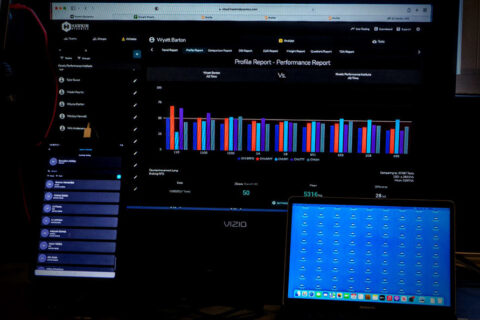
At KPI, one of the first things we do before the high school season is establish a readiness baseline for every athlete we train. Strength levels, throwing volume, intent exposure, arm health, and overall workload all matter. Without that context, managing athletes through the season becomes guesswork.
Preparation without context isn’t preparation at all.
The KPI Lens: Residuals Matter More Than Most Athletes Think
At KPI, we talk a lot about residuals—the ability of the body to retain training adaptations once training stops.
Winter training absolutely matters.
But here’s the hard truth: if training completely stops once the season begins, those gains don’t last.
Strength fades.
Power drops.
Tissue tolerance declines.
Movement quality erodes.
The longer athletes go without training, the faster those winter gains disappear.
This is where a lot of high school athletes go wrong. They train hard in the winter, then assume the season itself is enough to maintain progress.
It’s not.
Games express ability.
Training maintains and builds it.
What Smart In-Season Training Actually Looks Like
Let’s be clear—during the season, performance comes first.
But that doesn’t mean training disappears. It means training evolves.
Most high school teams play 2–3 games per week. For many athletes—especially those who are both pitchers and position players—this creates complex workload demands that must be managed intelligently.
That’s why high school athletes are best served by:
– Total-body strength training, not rigid body-part splits
– Lower volume, higher intent work focused on power and speed
– Enough recovery between sessions to avoid cumulative fatigue
– General physical preparation that supports all on-field demands
– For pitchers specifically, this often means:
– Maintaining strength and arm capacity
– Managing throwing volume and intent
– Performing mechanical work at lower intensities when appropriate
– Prioritizing arm care and recovery over constant “fixing”
Mechanical work still matters—but in-season, it must be precise, efficient, and stress-aware.
Why Winter Preparation Must Carry Into the Season
Winter training is where athletes build capacity.
The season is where that capacity gets tested.
If athletes want to:
– Stay healthy through the season
– Maintain velocity and bat speed
– Avoid late-season fatigue
– Actually improve year over year
– Then training cannot shut down once games start.
This is especially true in seasons that matter more—when athletes are trying to prove themselves, earn roles, or get on recruiting radars. Those moments don’t reward athletes who are worn down. They reward athletes who are prepared.
The KPI Difference: Preparing Athletes for the Entire Season
At KPI, winter training is never designed in isolation.
Everything we do in the winter is built to:
– Prepare athletes for the stress of the season
– Transition smoothly into in-season maintenance
– Manage workloads intelligently
– Keep athletes strong, fast, and resilient
We don’t just ask, “Are you ready for tryouts?”
We ask, “Can your body handle the next four months?”
That’s the difference between short-term readiness and long-term development.
Final Thought
The high school season isn’t the finish line.
It’s a checkpoint.
The athletes who stay healthy, productive, and confident through the season are the ones who:
– Trained with intent in the winter
– Transitioned intelligently into the season
– Continued to train while others shut it down
Preparation doesn’t end when the season starts.
That’s when it proves its value.
Train to get ready.
Train to stay ready.
And train with a system that understands both.
Every spring, the same pattern shows up across baseball.Athletes feel great in February.They’re excited, fresh, and confident after a winter of…
Every spring, it happens.A player isn’t starting.He’s not hitting where he wants in the lineup.His velocity hasn’t jumped.His role isn’t…